
For most of gaming history, LGBTQ+ characters were hidden in easter eggs, buried in subtext, or played as punchlines. Today they lead some of the biggest games ever made. This guide traces how queer representation in video games evolved, why it matters to players and the industry, and what it means for LGBTQ+ gamers and streamers today.
By the numbers: according to GLAAD’s 2024 Gaming Report, 17% of active gamers identify as LGBTQ+, up from 10% in 2020. Yet the same report found that fewer than 2% of games include LGBTQ+ characters or storylines.
The early years: subtext and punchlines
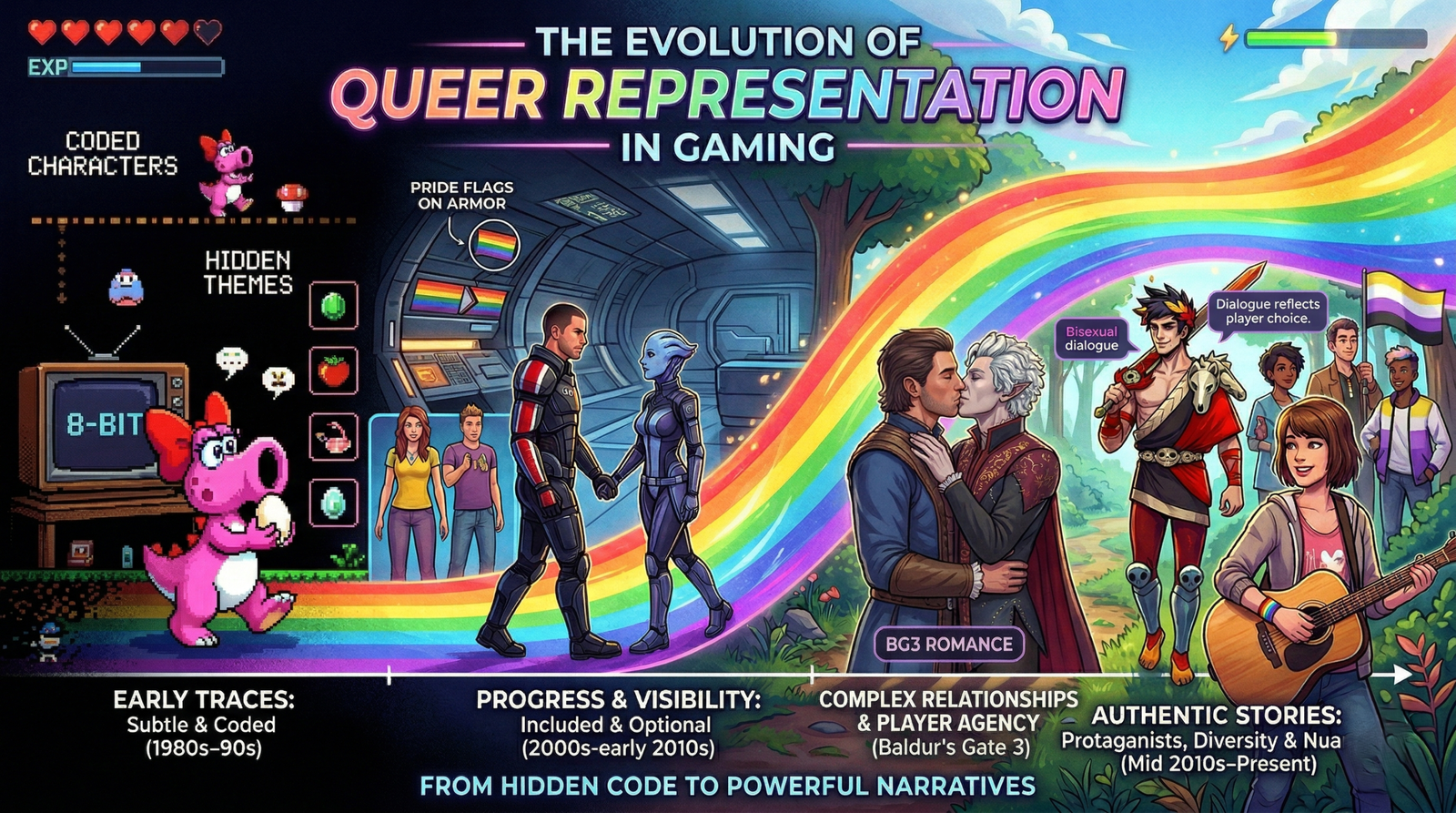
In the 1980s and early ’90s, LGBTQ+ characters were almost absent from games, or heavily censored when they did appear. One of the earliest examples is Birdo from Super Mario Bros. 2 (1988). The original manual described Birdo as a character who “thinks he is a girl”, which made Birdo one of gaming’s first trans-coded characters, even though Nintendo’s handling of that identity stayed inconsistent for years.
During this era, queer identities were usually “coded” rather than stated: characters hinted at their identity through stereotypes, often as villains or jokes, without ever confirming it. For queer players, finding themselves in games meant reading between the lines.
The power of choice: The Sims and BioWare
The turning point came from player choice. The Sims (2000) let players form same-sex relationships, a feature that made it into the game after a programmer added it during development. It showed that players wanted their digital lives to reflect their real ones, and the game became one of the best-selling PC franchises ever.
BioWare’s Mass Effect and Dragon Age series went further, letting players pursue same-gender romances in big-budget RPGs. These paths were optional, so queerness was still something players had to opt into, but they were vital milestones in bringing LGBTQ+ stories into blockbuster games.
The indie revolution
While big studios moved slowly, independent developers took the risks that changed what games could be:
- Gone Home (2013): a first-person story about a young woman uncovering her sister’s coming-out story. It proved a game without combat could be deeply moving.
- Celeste (2018): a platformer about climbing a mountain that doubles as a story about anxiety. In 2020, creator Maddy Thorson confirmed that its protagonist, Madeline, is trans.
- Hades (2020): Supergiant Games’ mythological roguelike lets protagonist Zagreus pursue relationships with both men and women, treating it as a natural part of the world rather than a headline.
Queer protagonists go mainstream
The next step was defined protagonists whose LGBTQ+ identity is part of who they are, not something the player picks.
- Life is Strange (2015) built its story around the evolving bond between Max and Chloe, bringing queer teenage experiences to a large audience.
- The Last of Us: Left Behind (2014) and The Last of Us Part II (2020) made Ellie, a lesbian, the lead of one of PlayStation’s biggest franchises. Part II also introduced Lev, a trans teenager.
- Tell Me Why (2020), published by Xbox, featured Tyler, a trans man, as a playable lead, developed with input from LGBTQ+ advocates.
Character creation beyond the binary
Character creators have also changed. Cyberpunk 2077 separates body type from voice and pronouns, and Baldur’s Gate 3 (2023), which won Game of the Year at The Game Awards, lets players romance companions regardless of gender. In hero shooters, Overwatch includes openly gay and lesbian heroes like Soldier: 76 and Tracer, and Apex Legends features non-binary legends such as Bloodhound.
For many players, being able to create a character that matches their own identity isn’t a minor feature. It’s the first time a game has truly let them be themselves.
Why representation matters
Seeing yourself
Representation tells players they belong. For LGBTQ+ players, especially younger ones, seeing a character like them treated as a hero rather than a joke can be powerful. And because games are interactive, they build empathy in a way film and TV can’t: you don’t just watch a character’s story, you play it.
It’s good business
The “it’s just a trend” argument doesn’t hold up. With nearly one in five active gamers identifying as LGBTQ+ in GLAAD’s research, inclusive games are serving a big, growing part of their audience. Some of the most acclaimed games of the past decade, including The Last of Us Part II, Hades and Baldur’s Gate 3, feature LGBTQ+ characters and stories prominently.
There’s still a long way to go
Fewer than 2% of games include LGBTQ+ content, according to GLAAD, and representation behind the scenes, in writing rooms and on development teams, still lags. Critics also point to “rainbow washing”: marketing that celebrates inclusion without meaningful representation in the games themselves.
For LGBTQ+ streamers: building a safe space
Representation matters on stream too. GLAAD’s report found that 52% of LGBTQ+ gamers have experienced harassment in online and multiplayer games, compared with 38% of non-LGBTQ+ players. If you’re an LGBTQ+ creator, these tools help you build a safer community:
- Use the LGBTQIA+ tag on Twitch so viewers looking for queer creators can find you.
- Set up AutoMod and blocked terms before you go live, so slurs and harassment are filtered automatically.
- Learn Shield Mode on Twitch: a one-click way to tighten your chat settings during a harassment raid.
- Recruit moderators you trust, and write clear chat rules that make your channel’s values obvious from the start.
Our guide to building a loyal community on Twitch covers moderation and community culture in more depth.
The road ahead
From Birdo’s manual entry to Ellie leading one of gaming’s biggest franchises, LGBTQ+ representation has come a long way, and it’s no longer a footnote. As a new generation of players and developers shapes the industry, games are becoming as diverse as the people who play them. LGBTQ+ visibility isn’t a trend, because people aren’t a trend.