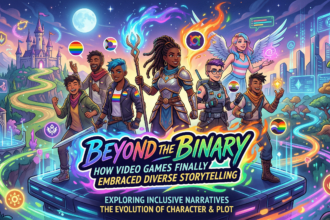
Exploring the journey of LGBTQ+ characters from the margins of code to the center of the story.
The Early Years: Shadows and Subtext
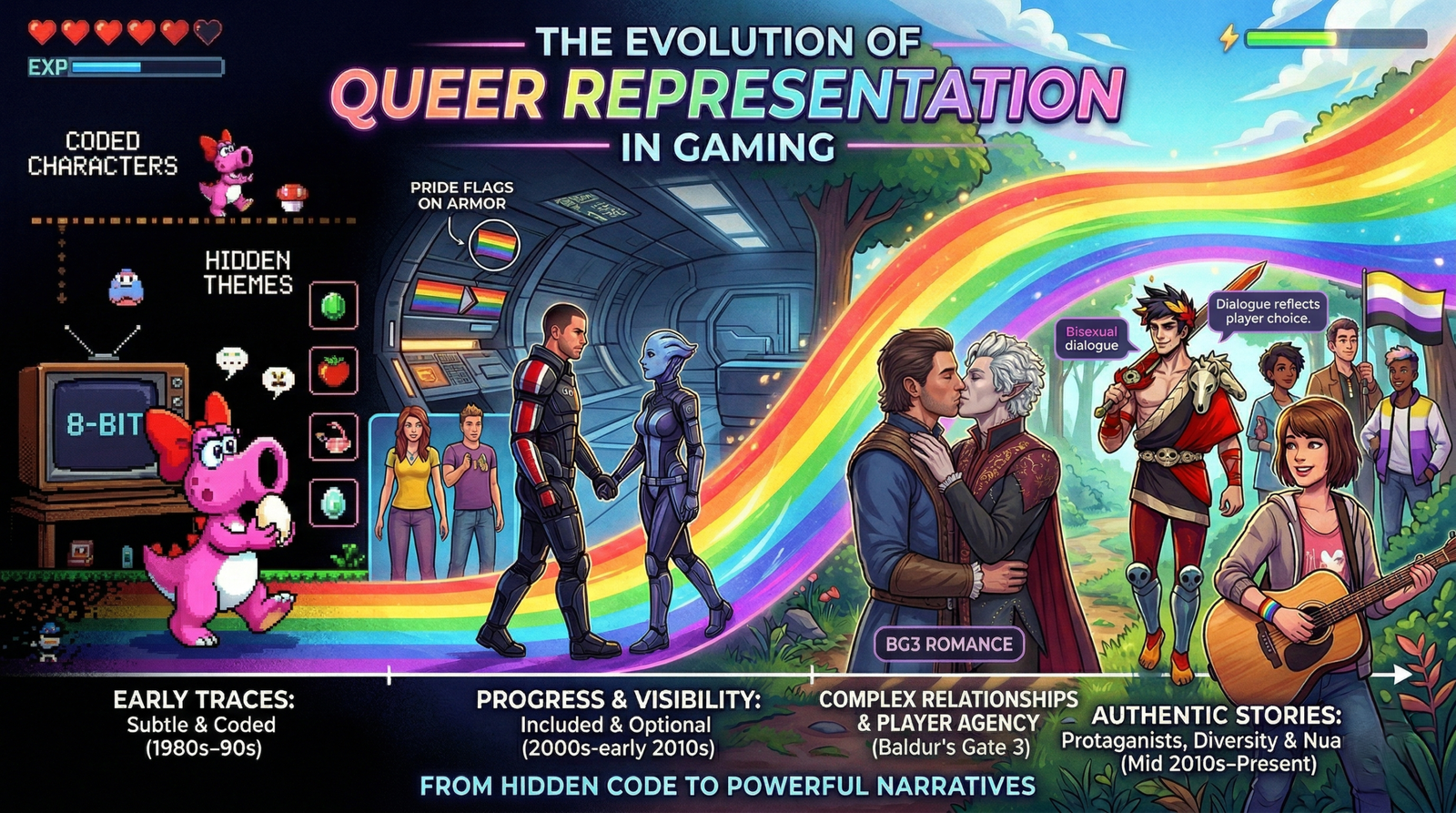
In the 1980s and early 90s, LGBTQ+ presence in games was almost non-existent or heavily censored. When queer characters did appear, they were often relegated to “Easter Eggs” or punchlines. One of the earliest examples is 1988’s Super Mario Bros. 2, which introduced Birdo. The original manual stated Birdo was a boy who “thinks he is a girl,” making her one of the first trans icons in gaming, though the industry’s handling of her identity was inconsistent and often clumsy for years.
During this era, queer identities were frequently “coded” rather than stated. Characters displayed stereotypical traits that hinted at their orientation without ever confirming it, allowing developers to avoid the ire of ratings boards while providing a breadcrumb trail for queer players searching for themselves in digital worlds.
The BioWare Revolution: The Power of Choice
The early 2000s marked a seismic shift with the rise of the Western RPG. Developers like BioWare and Maxis began to realize that players wanted their digital avatars to reflect their real-world identities.
In 2000, The Sims famously allowed same-sex relationships—originally the result of a programmer implementing a feature that had been officially “tabled.” The massive success of the game proved there was a huge market for inclusive storytelling. Later, titles like Dragon Age and Mass Effect broke ground by allowing players to pursue romance with characters of the same gender. While these were “optional” paths, they were vital milestones in legitimizing queer existence in blockbuster titles.
The Narrative Pivot: Defined Protagonists
While the “player-choice” era was a victory, it still categorized queerness as a secondary option. The next evolution came when developers began creating defined protagonists whose queer identities were central to their fixed narrative.
The most notable example is Ellie from The Last of Us series. In the Left Behind DLC and eventually The Last of Us Part II, Ellie’s identity as a lesbian was not a choice made by the player, but a fundamental part of her character. This was a watershed moment: a AAA, multi-million dollar franchise was being led by a queer woman. Similarly, Life is Strange used its time-bending mechanics to explore the intimate, evolving bond between Max and Chloe, bringing queer adolescent experiences to the forefront of the indie-gone-mainstream scene.
The Indie Frontier and Gender Identity
While AAA studios move slowly, the indie scene has been a crucible for radical representation. Games like Celeste, developed by Maddy Thorson, subtly but powerfully confirmed its protagonist, Madeline, as transgender. Hades by Supergiant Games was celebrated for its casual and fluid depiction of bisexuality and polyamory, treating these dynamics as a natural part of its mythological world.
“Representation isn’t just about having a character in the background; it’s about whose hands are on the controller and whose story is being told as the ‘default’ human experience.”
The Path Ahead
Today, we see a more nuanced landscape. We see non-binary characters in Apex Legends, trans narratives in Tell Me Why, and a wide spectrum of identities in Cyberpunk 2077. However, the journey isn’t over. The industry still struggles with “rainbow washing” and the need for more diverse voices in the writers’ rooms themselves.
The evolution from a hidden Easter egg in a 2D platformer to the complex, flawed, and heroic protagonists of today proves that gaming is growing up. It is no longer just about the high score; it’s about the shared human experience, in all its colorful diversity.